The Ledgered Economy: Being an Employer and Employee in 2050
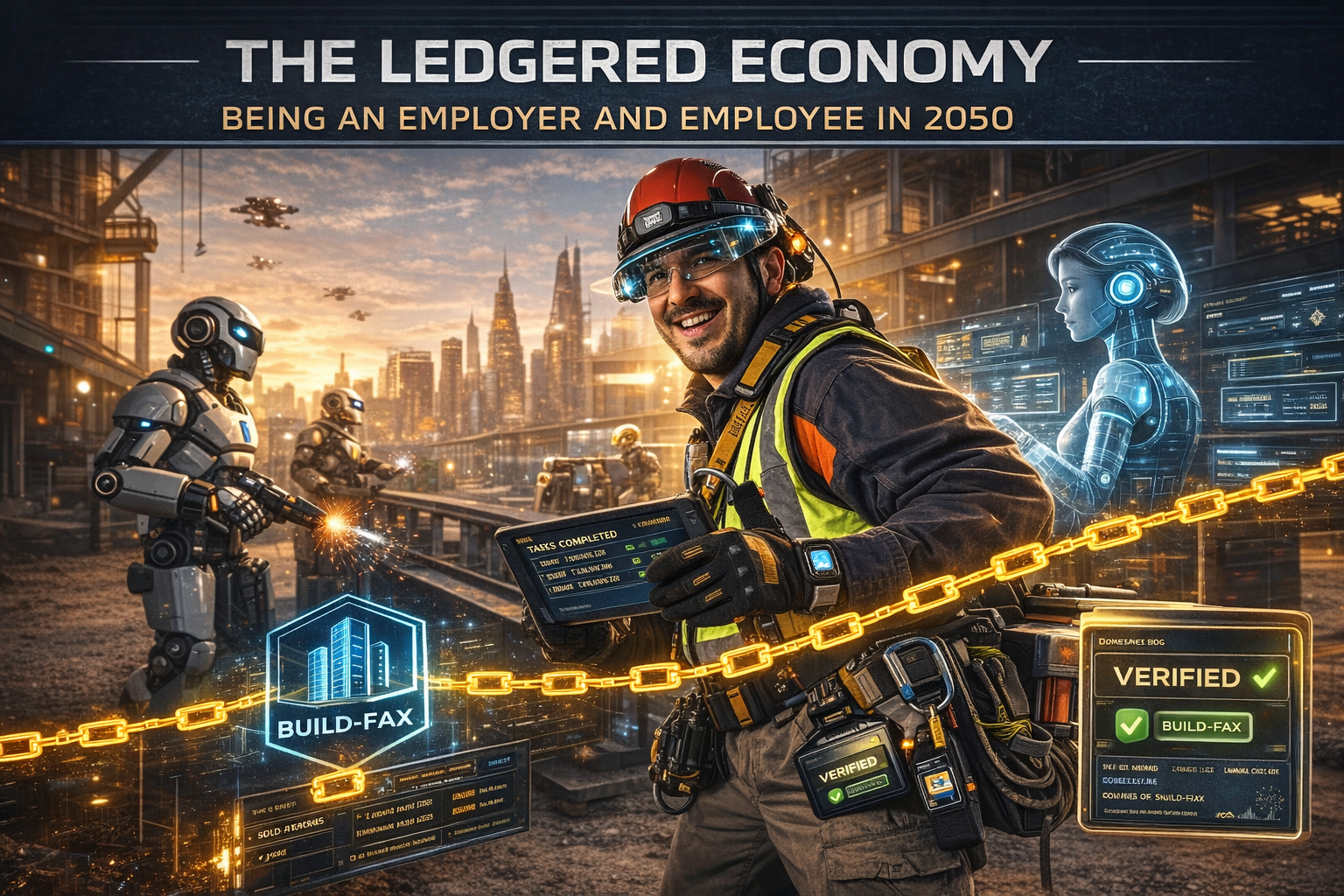
We may be entering a period where productivity keeps rising, but employment does not rise with it in the same way.
That is a much bigger shift than most people realize.
For decades, economic growth, corporate growth, and job creation were closely linked. If a company wanted to scale, it usually needed more people. More headcount meant more wages, more payroll taxes, more consumer spending, and ultimately a larger economy.
AI and robotics may break that equation.
A future is now visible where companies generate significantly more output with fewer people. That could mean higher margins, faster execution, and much stronger returns on capital. But it also raises a harder question:
What happens to the economy when labor is no longer the main engine of value creation?
This is not just a workforce discussion. It is a tax, policy, and market structure discussion.
The real issue is not job loss alone
I do not think the future is simply “humans replaced by robots.”
The more likely future is more nuanced.
Many jobs will not disappear completely. They will be redesigned. Employees will increasingly manage systems, review outputs, make judgment calls, build trust, solve exceptions, and own relationships while AI agents and robots handle a growing share of execution.
That sounds efficient — and it is.
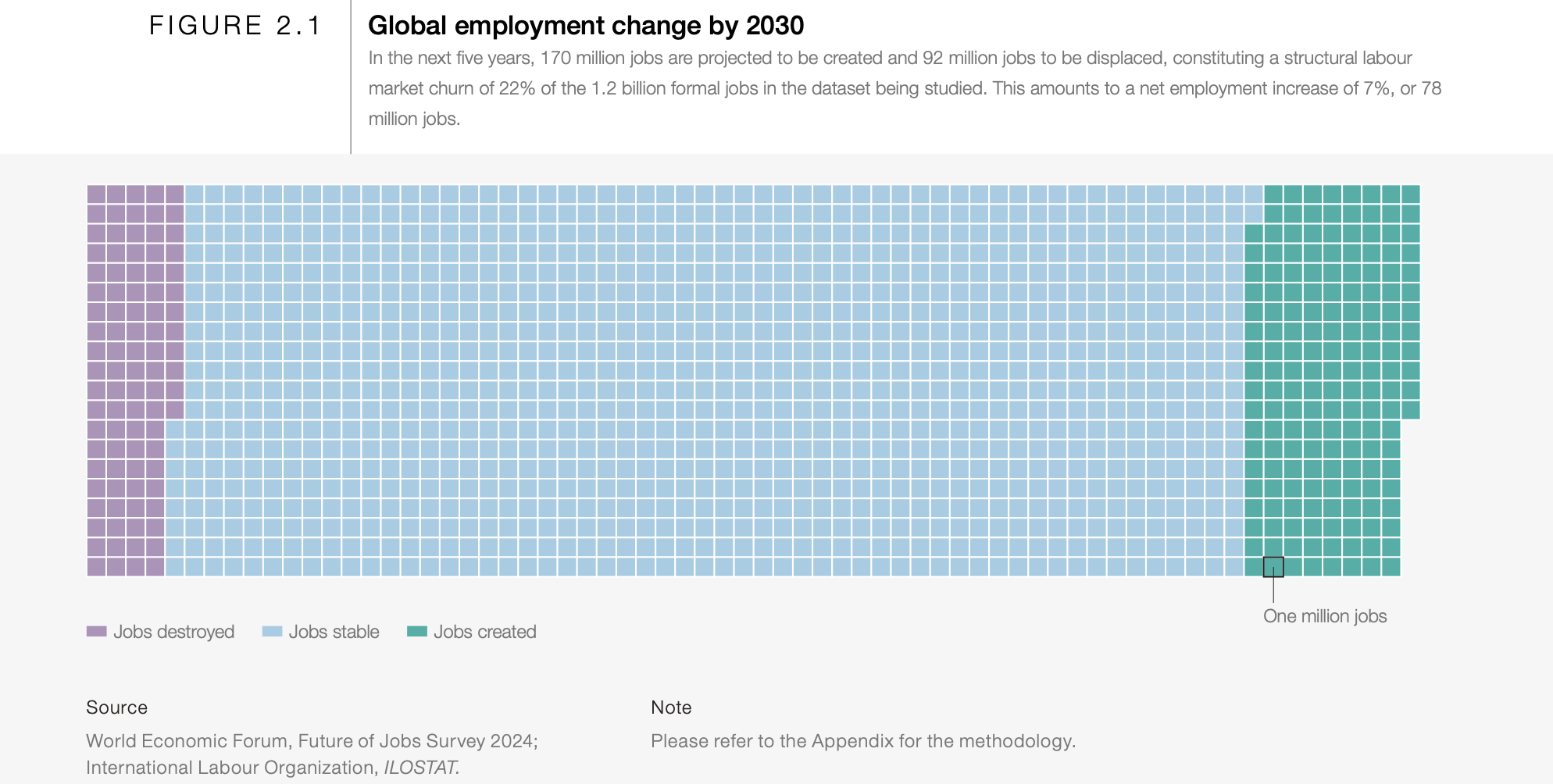
Source: The Future of Jobs Report 2025, WEF
But from a government and societal standpoint, there is a second-order effect that matters even more:
If companies need fewer employees, then payroll-based tax systems start weakening.
That changes everything.
Today, governments rely heavily on human labor as a tax base. Employers pay through payroll taxes. Employees pay through income taxes. Consumers spend their wages back into the economy. If AI compresses the human share of production, governments may eventually find themselves in a strange position:
Higher national productivity, but a weaker labor-linked tax base.
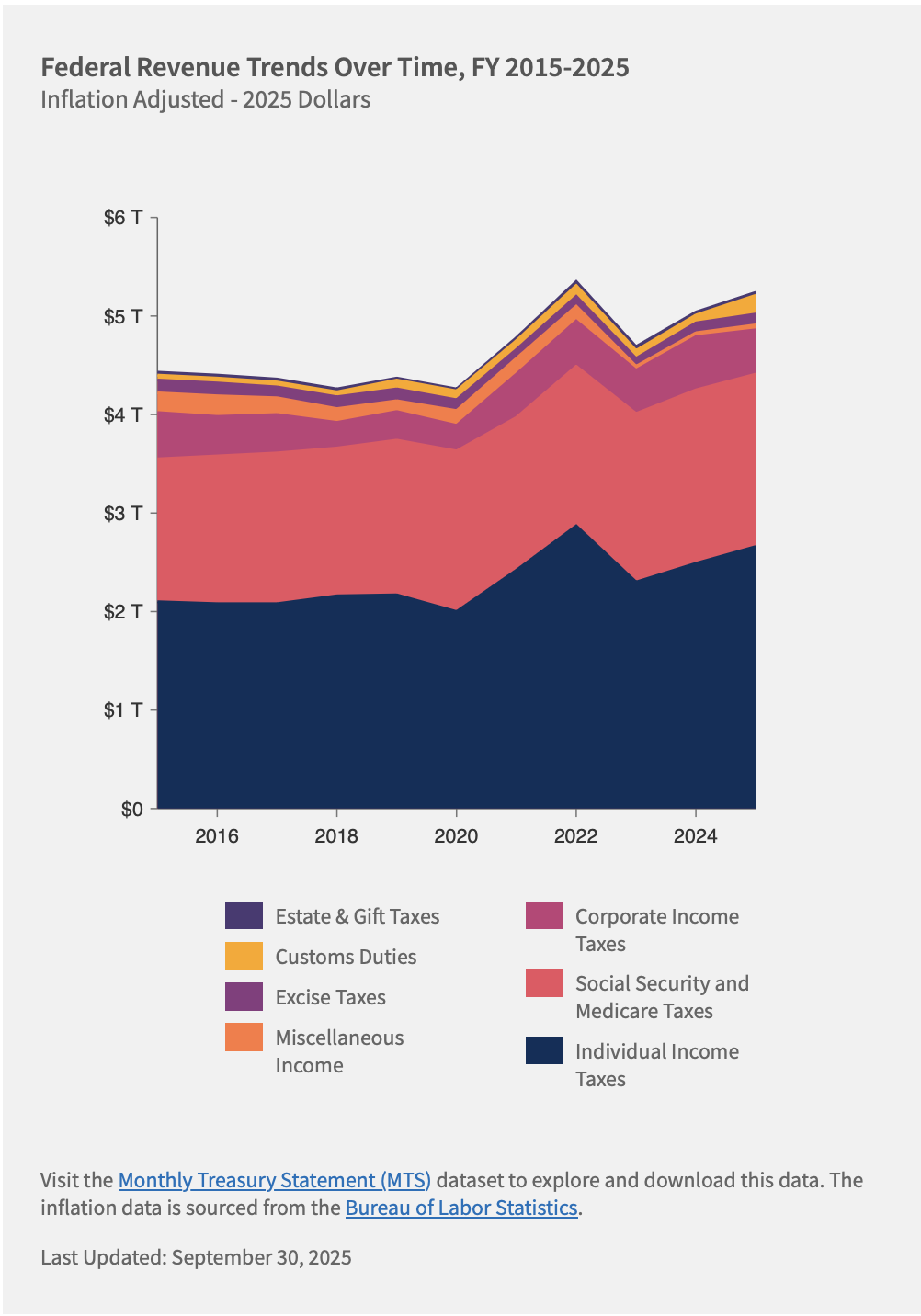
Source: FiscalData - treasury.gov
So should governments tax robots and AI agents?

Possibly — but not in the simplistic way the phrase “robot tax” suggests.
Taxing every robot or AI tool as if it were a human employee feels too crude. It could slow innovation, create loopholes, and punish productive investment.
The real objective should be broader:
How do we tax value creation in an economy where value is increasingly generated by software, autonomous systems, and capital rather than labor?
That opens the door to more serious ideas:
Taxing autonomous economic output rather than just human wages
Taxing excess returns or capital concentration created by AI scale
Redesigning corporate tax logic around productivity with low headcount
Creating new funding mechanisms for retraining, transition support, and lifelong learning
Shifting part of the fiscal model from labor taxation toward capital, digital services, or machine-generated value
The question is not whether a robot should “pay taxes.”
The question is whether governments can continue using 20th century tax architecture in a 21st century production model.
What employment could look like in 2050
I see at least three realistic scenarios.
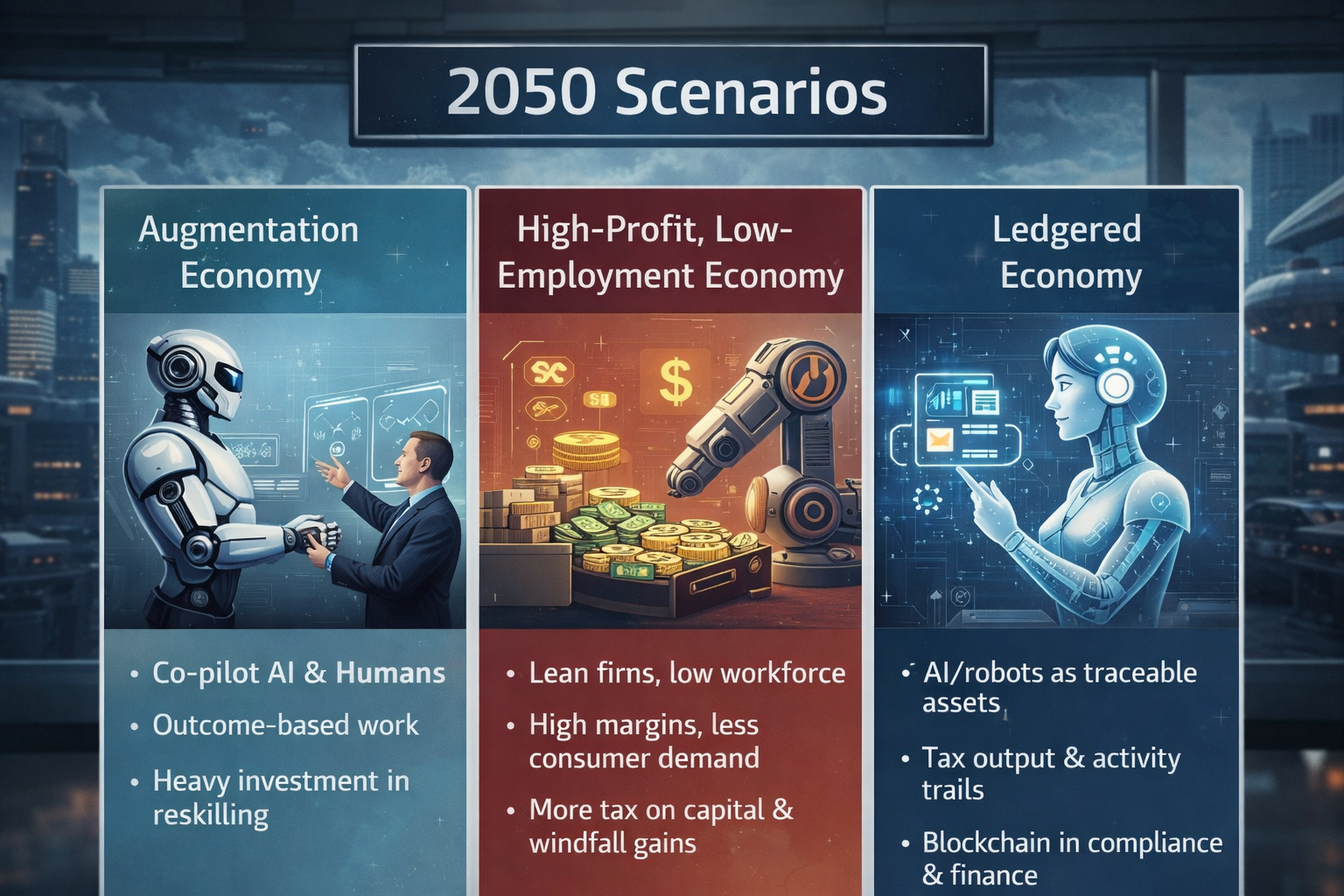
1. The augmentation economy
This is the optimistic path.
AI becomes a multiplier, not a mass replacement engine. Companies still employ people, but fewer of them are doing repetitive work. More are directing systems, validating outcomes, and focusing on creativity, judgment, and relationships.
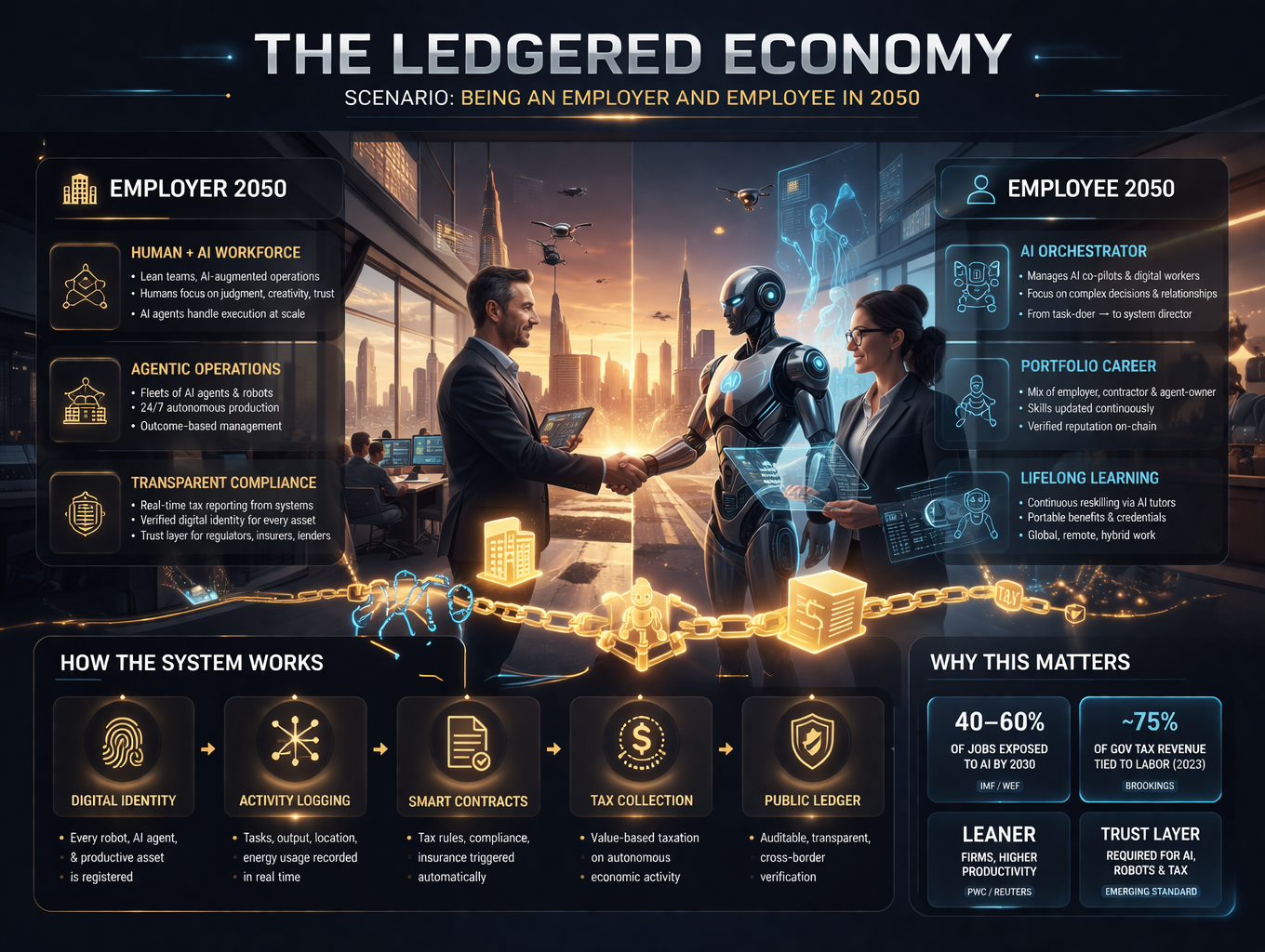
In this version of 2050, employees become orchestrators. Employers become far more productive without becoming detached from society. Jobs evolve, but work still exists at scale.
2. High-profit, low-employment capitalism
This is the scenario leaders should take seriously.
Companies become leaner and much more profitable. A smaller workforce produces more. Shareholders initially benefit. Some firms command premium valuations because they can scale without adding labor.
But there is a catch.
If enough households lose wage income or bargaining power, aggregate demand weakens. The same companies benefiting from automation may eventually face a smaller or more fragile market because fewer people have the purchasing power to sustain consumption.
That creates a paradox:
Companies win individually, while the economy weakens collectively.
3. The ledgered economy
This is the one I find most interesting.
In this future, AI agents and robots are not treated as people, but they are treated as traceable economic actors. Every productive asset has a digital identity, a usage history, an owner, and a record of the value it helped create.
That is where blockchain becomes relevant in a practical way.
Not as hype. Not as speculation.
As infrastructure.
If autonomous systems are going to operate inside factories, offices, logistics networks, and buildings, then we will need trusted records of what they did, where they operated, who owned them, what standards they met, and what economic value they generated.
That is not only useful for tax. It is useful for insurance, compliance, financing, maintenance, regulation, and transaction trust.
Why this matters to me?
I keep coming back to one thought:
In the future, the most important economic asset may not just be labor or capital. It may be verified economic activity.
That is where blockchain can quietly play a major role.
And that is also where I see a connection to Build-fax.
If buildings in the future become platforms for autonomous activity — with robots, AI systems, sensors, digital twins, and machine-led operations inside them — then the building itself may need a trusted digital identity layer.
Not just what it is.
But what happened inside it.
Who installed what.
Which systems operated there.
What upgrades were made.
What risks emerged.
What value was created.
In that world, Build-fax is not just about a building’s history. It could become part of the trust layer for the economy that sits on top of it.
The Future
By 2050, the biggest disruption may not be that AI replaces some jobs.
It may be that our institutions still assume that humans are the primary unit of production.
If that assumption breaks, then being an employer and being an employee will both mean something very different.
And the countries and companies that adapt first will not just be more efficient.
They will be more durable.
References:
WEF Future of Jobs Report 2025
IMF AI and jobs article
Brookings AI tax-policy piece
ILO GenAI jobs update
WEF Global Risks Report 2026
Treasury Fiscal Data
FRED PAYEMS